Mediterranean Sea
The Myth of SisyphusThe Mediterranean Sea is not merely a setting but a physical and philosophical presence. Along its shores, the book locates a form of knowledge grounded in sunlight, water, stone, flesh, and immediate sensation. The sea gives the coastal cities their openness and abundance, yet its permanence also outlasts human projects, inviting both exhilaration and despair. Against the abstractions of history and the promises of the future, it offers a difficult truth: the world remains indifferent, beautiful, and present.
The Sea and the Open City
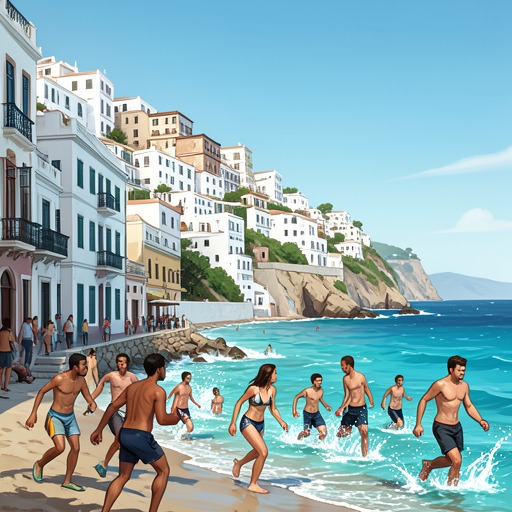
In Algiers, the Mediterranean Sea defines the city’s emotional geography. Unlike old walled towns such as Paris, Prague, and Florence, which seem closed in upon themselves, Algiers opens toward the sky and the water. The sea appears at the end of every street, making the world feel immediately available and allowing inhabitants to measure their possessions through direct experience. Its abundance is not an intellectual lesson or a promise of improvement; it gives itself fully, through sunlight, warmth, and bodily pleasure.
That generosity has a severe underside. The country nourished by such natural riches offers no consolation and no future-oriented hope. Its pleasures are described as final rather than redemptive, requiring lucidity instead of faith. The sea therefore joins splendor to destitution: the sensitive person receives an intense physical world while remaining exposed to its bitterness. This is why affection for the country is felt most deeply amid its poorest men, whose lives are surrounded by beauty without being protected from hardship.
Bodies, Sunlight, and Collective Life
The Mediterranean Sea becomes a theater of bodily existence. In Algiers, people do not simply go swimming; they “indulge in a swim,” and they swim in the harbor, rest on buoys, and continue exposing themselves to the sun even in winter. Young men undress at noon for a frugal meal in the sunlight, not because they follow an abstract doctrine of nudism, but because they are comfortable in their bodies and in the climate that surrounds them.
This exposure is connected with a long cultural history. Young men running on Mediterranean beaches repeat the gestures of the athletes of Delos, while the naked body reappears after centuries in which social custom attempted to diminish flesh through dress and decency. The body is treated as having its own history, development, reversals, and deficiencies. Its changing colors, from white through gold and tan to tobacco, register the summer’s sustained pressure, while the white cubes of the Kasbah rise above the harbor and the bodies below form a copper-colored frieze against the Arab town.
The sea also creates collective movement. Mornings are spent diving, laughing, and paddling around red and black freighters whose odors recall wood, oil, wine, and old casks. An orange canoe carries brown bodies home in a mad race, then glides through the inner harbor as the double paddle falls silent. In that transition from strenuous play to calm water, the narrator imagines himself piloting a savage cargo of gods who are also his brothers. Human community is thus figured not as an institution or doctrine but as shared immersion in water, light, labor, and pleasure.
At Padovani Beach, the dance hall opens directly toward the sea. When its wooden awnings rise at sunset, an unusual green light, produced by the doubled surface of sky and water, fills the room. Dancers pass as silhouettes against the sky; a waltz makes their black profiles whirl like cut-outs on a phonograph. The sea transforms ordinary dancing into a fleeting spectacle in which bodies, desire, flowers, sweat, and evening light become inseparable. The narrator associates such moments with innocence, not because they are free of desire, but because their desires remain visibly joined to the natural world.
Nature Against the Modern City
The Mediterranean Sea is also the standard by which modern Europe appears diminished. In the account of Greek tragedy, beauty and suffering remain joined: the Mediterranean sun can make despair appear through a beauty so complete that it becomes stifling. Greek thought is presented as retaining limits, balancing shadow with light, whereas modern Europe pursues totality, glorifies the future, and turns history and reason into instruments of domination.
The modern city deliberately cuts itself off from the sea, hilltops, nature, and evening meditation. Consciousness is declared to exist in the streets because history is believed to exist there, but this narrowing leaves literature and philosophy unable to account for the natural universe that preceded history or the beauty that rises above it. The Mediterranean stands for what this urban and historical consciousness has amputated. Between the sky and faces turned toward it, there is no mythology or system to shelter behind—only stones, flesh, stars, and truths that can be touched.
The sea therefore resists the replacement of human nature by historical situation. It preserves a world in which values are not manufactured at the end of political action but encountered in the limits of bodies, seasons, and mortality. Its presence does not provide a supernatural solution. Instead, it prevents abstraction from becoming complete by continually returning thought to the visible and material world.
Enclosure, Boredom, and the Return of the Landscape
Oran provides the Mediterranean’s negative counterpart. Although the city lies beside a wonderful landscape, its inhabitants have covered it with ugly constructions. Apart from the Spanish quarter, Oran turns its back on the sea and curls inward like a snail. It becomes a circular yellow wall beneath a leaden sky, a labyrinth in which the visitor searches for the sea as though following Ariadne’s sign. The Minotaur at the center of this maze is boredom, and the citizens have ceased wandering because they have accepted being consumed by it.
The city’s streets, shops, cafes, photography studios, funeral establishments, and sporting clubs make this enclosure material. Dust, pebbles, heat, mud, bad taste, commercial display, and repetitive entertainments replace the open relation to sea and sky. Even the photographers’ studios manufacture artificial figures that cannot be encountered in ordinary life, while the boxing club gathers a sweating crowd into a whitewashed, corrugated-iron box. Yet the boxing match briefly restores an elemental relation to bodies: two fighters exchange blows and blood, and the crowd receives and returns their violence until the entire hall seems to vibrate with the effort.
The sea remains outside this urban enclosure, indifferent but persistent. Oran’s monumental labor attempts to attack the stone coast and extend itself into the bay. Machines tear gravel from the cliff and dump it into the water to form a jetty, but the stones are only moved from one place to another and will outlast the men who use them. The true monuments of Oran are therefore still its stones, not because human work triumphs over nature, but because the material world absorbs and exceeds that work.
Memory, Solitude, and Belonging
The Mediterranean Sea makes solitude possible without becoming empty. In a world with no deserts or islands left for retreat, the great cities can still provide isolation if their conditions are understood. Oran’s ugliness, boredom, and indifferent sky strip away distractions until the human creature becomes the only remaining object of attention. The sea beyond the city’s walls continues its dialogue with the land, refusing to disappear simply because people have walled themselves away from it.
This persistence gives the sea a double power. It first interests, then bores, and finally wins through obstinacy; its permanence can drive the heart to despair while also exciting it. At the gates of Oran, the wastelands toward Canastel, the mountain of Santa-Cruz, and the ravines above the bay restore the landscape that the city has rejected. Solitary paths over red stone and above the motionless bay become places of return to nakedness and luminous experience.
The same power governs the journey back to Tipasa. After a prolonged rain in Algiers, the weather suddenly clears, and a limpid morning gives every house and tree a sharp, astonished newness. The narrator sets out again toward the sea, carrying memories of childhood, adolescence, beaches, young bodies, desire, and the recurring sky. The Mediterranean is not simply remembered as scenery: it organizes the memories through which a life recognizes itself. The Chenoua, first a blue haze confused with the sky and then a solid mass rising above the water, becomes an old, immovable god and a refuge for those who belong to its shore.
The sea’s decisive significance lies in this combination of immediacy and endurance. It offers no promise of eternity outside the sweep of days, but it provides a durable form of attachment within them. Sun, water, stone, and flesh become relative truths that can be possessed, sensed, and loved. The Mediterranean Sea thus embodies a happiness without transcendence and a sorrow without illusion: it is beautiful because it does not redeem human life, and necessary because its indifference keeps human attention faithful to the world.